what program allows millions of us soldiers to get a subsidized college education?
 | |
| Long championship | AN ACT To provide Federal Authorities aid for the readjustment in civilian life of returning World War II veterans |
|---|---|
| Nicknames | Chiliad.I. Bill |
| Enacted past | the 78th United States Congress |
| Citations | |
| Public police force | Pub.L. 78–346 |
| Statutes at Large | 58 Stat. 284 |
| Legislative history | |
| |
The Servicemen's Readjustment Deed of 1944, commonly known equally the G.I. Pecker, was a law that provided a range of benefits for some of the returning Earth War II veterans (commonly referred to every bit M.I.south). The original Grand.I. Bill expired in 1956, but the term "G.I. Neb" is still used to refer to programs created to assist some of the U.S. military veterans.
It was largely designed and passed through Congress in 1944 in a bipartisan endeavour led by the American Legion who wanted to reward practically all wartime veterans. Since the Start World War the Legion had been in the forefront of lobbying Congress for generous benefits for state of war veterans.[1] Roosevelt, by contrast, wanted a much smaller program focused on poor people regardless of military service.[two] The terminal neb provided immediate fiscal rewards for practically all Globe War Ii veterans, thereby avoiding the highly disputed postponed life insurance policy payout for World War I veterans that had caused political turmoil in the 1920s and 1930s.[iii] Benefits included depression-toll mortgages, low-interest loans to offset a business or farm, 1 year of unemployment compensation, and defended payments of tuition and living expenses to attend high school, college, or vocational school. These benefits were available to all veterans who had been on active duty during the war years for at to the lowest degree 90 days and had not been dishonorably discharged.[4]

By 1956, 7.eight million veterans had used the G.I. Bill education benefits, some ii.two million to attend colleges or universities and an additional 5.half dozen 1000000 for some kind of training programme.[5] Historians and economists judge the G.I. Beak a major political and economic success—specially in contrast to the treatments of Earth War I veterans—and a major contribution to U.S. stock of homo upper-case letter that encouraged long-term economical growth.[6] [7] [8] However, the M.I. Bill received criticism for directing some funds to for-profit educational institutions. The Yard.I. Bill was racially discriminatory, equally it was intended to accommodate Jim Crow laws. Due to the discrimination by local and land governments, as well every bit by private actors in housing and teaching, the K.I. failed to benefit African Americans as it did with white Americans. Columbia University historian Ira Katznelson described the G.I. Pecker as affirmative activity for whites.[9] The G.I. Bill has been criticized for increasing racial wealth disparities.[x]
The Post-nine/11 Veterans Educational Assistance Deed of 2008 further expanded benefits, providing veterans with funding for the full toll of any public higher in their state. The G.I. Bill was also modified through the passage of the Forever GI Bill in 2017.
History [edit]
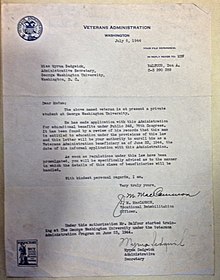
On June 22, 1944, the Servicemen's Readjustment Deed of 1944, commonly known equally the M.I. Bill of Rights, was signed into law. Professor Edwin Amenta states:
- Veterans benefits were a bargain for conservatives who feared increasingly high taxation and the extension of New Deal national government agencies. Veterans benefits would get to a pocket-sized group without long-term implications for others, and programs would be administered by the VA, diverting power from New Bargain bureaucracies. Such benefits were likely to hamper New Dealers in their attempts to win a postwar battle over a permanent system of social policy for everyone.[12]
During the war, politicians wanted to avoid the postwar defoliation virtually veterans' benefits that became a political football in the 1920s and 1930s.[13] [14] Veterans' organizations that had formed subsequently the First World War had millions of members; they mobilized support in Congress for a bill that provided benefits only to veterans of military service, including men and women. Ortiz says their efforts "entrenched the VFW and the Legion as the twin pillars of the American veterans' lobby for decades."[15] [sixteen]
Harry Due west. Colmery, Republican National Committee chairman and a former National Commander of the American Legion, is credited with writing the first draft of the K.I. Bill.[17] [18] He reportedly jotted down his ideas on stationery and a napkin at the Mayflower Hotel in Washington, D.C.[xviii] A grouping of 8 from the Salem, Illinois American Legion have also been credited with recording their ideas for veteran benefits on napkins and paper. The group included Omar J. McMackin, Earl Due west. Merrit, Dr. Leonard W. Esper, George H. Bauer, William R. McCauley, James P. Ringley, A.L. Starshak and Illinois Governor, John Stelle who attended the signing ceremony with President Roosevelt.[19]
U.South. Senator Ernest McFarland, (D) AZ, and National Commander of the American Legion Warren Atherton, (R) CA were actively involved in the bill'south passage and are known the "fathers of the Thou.I. Bill." 1 might and so term Edith Nourse Rogers, (R) MA, who helped write and who co-sponsored the legislation, every bit the "mother of the G.I. Beak". As with Colmery, her contribution to writing and passing this legislation has been obscured past time.[20]

A government poster informing soldiers about the K.I. Bill
The bill that President Roosevelt initially proposed had a means exam—only poor veterans would get one year of funding; only top-scorers on a written exam would get four years of paid college. The American Legion proposal provided full benefits for all veterans, including women and minorities, regardless of their wealth.
An important provision of the Thousand.I. Neb was low interest, goose egg down payment abode loans for servicemen, with more favorable terms for new construction compared to existing housing.[21] This encouraged millions of American families to move out of urban apartments and into suburban homes.[22]
Some other provision was known as the 52–xx clause for unemployment. Unemployed war veterans would receive $xx once a week for 52 weeks for upward to one twelvemonth while they were looking for work. Less than 20 per centum of the money set aside for the 52–20 Guild was distributed. Rather, nigh returning servicemen speedily establish jobs or pursued higher education.
The recipients did not pay any income taxation on the GI benefits, since they were not considered earned income.[23]
The original 1000.I. Bill ended in 1956.[24] A variety of benefits accept been bachelor to armed services veterans since the original bill, and these benefits packages are commonly referred to as updates to the G.I. Bill.
Subsequently World War Two [edit]
A greater percentage of Vietnam veterans used Yard.I. Bill instruction benefits (72 pct)[25] than World War Two veterans (49 per centum)[26] or Korean War veterans (43 percent).[25]
Canada [edit]
Canada operated a similar programme for its World War Ii veterans, with a similarly beneficial economic touch.[27]
Problems [edit]
Racial discrimination [edit]
The K.I. Neb aimed to help American World War 2 veterans accommodate to noncombatant life past providing them with benefits including low-cost mortgages, low-interest loans and financial support. One historian, Ira Katznelson, argues that "the law was deliberately designed to accommodate Jim Crow".[28] In the New York and northern New Jersey suburbs 67,000 mortgages were insured past the K.I. Pecker, merely fewer than 100 were taken out by non-whites.[29] [30]
Additionally, some banks and mortgage agencies refused loans to black people.[31] After the war, many people, black people included, returned to their former lives of poverty, making information technology hard for them to pursue the college education opportunities afforded by the G.I. Bill.
In the S, which was still segregated at that fourth dimension, some universities refused to acknowledge black people until the Ceremonious Rights movement. Colleges accepting black people in the S initially numbered 100. Some of those institutions were of lower quality, with 28 of them classified equally sub-baccalaureate. Only 7 states offered postal service-baccalaureate training, while no accredited engineering or doctoral programs were available for blacks. These institutions were all smaller than white or not-segregated universities, often facing a lack of resource.[32]
By 1946, but one fifth of the 100,000 black people who had applied for educational benefits had been registered in higher.[31] Furthermore, historically black colleges and universities (HBCUs) came nether increased pressure equally rising enrollments and strained resource forced them to turn away an estimated 20,000 veterans. HBCUs were already the poorest colleges. HBCU resource were stretched even thinner when veterans' demands necessitated an expansion in the curriculum beyond the traditional "preach and teach" course of study.[31]
Though blackness people encountered many obstacles in their pursuit of G.I. benefits, the bill greatly expanded the population of African Americans attention college and graduate schoolhouse. In 1940, enrollment at Black colleges was i.08% of total U.S. higher enrollment. Past 1950 it had increased to 3.6%. Withal, these gains were express almost exclusively to Northern states, and the educational and economic gap between white and black nationally widened nether the furnishings of the 1000.I. Bill.[33] With 79 percent of the black population living in southern states, educational gains were limited to a pocket-sized function of blackness The states.[31]
Merchant marine [edit]
Congress did not include the merchant marine veterans in the original Chiliad.I. Bill, even though they were considered military personnel in times of war in accordance with the Merchant Marine Act of 1936. Every bit President Roosevelt (Democrat) signed the 1000.I. Bill in June 1944 he said, "I trust Congress will presently provide similar opportunities to members of the merchant marine who have risked their lives time and time again during state of war for the welfare of their country." Now that the youngest World War II veterans are in their 90s, efforts accept been made to recognize the merchant mariners' contributions by giving some benefits to the remaining survivors. In 2007, three unlike bills to address this issue were introduced in Congress, of which one only passed in the House of Representatives.[34] The Belated Thank you to the Merchant Mariners of World State of war 2 Act of 2007 establishes Merchant Mariner equality compensation payments past the Secretary of Veterans Diplomacy of a monthly do good of $1,000 to each individual who, betwixt December 7, 1941, and Dec 31, 1946, was a documented member of the U.South. Merchant Marine (including Army Ship Service and the Naval Transport Service). This bill was introduced to the House by Rep. Bob Filner (D-California) in 2007 and passed the House simply not the Senate then did non become constabulary.[35] Another attempt to observe Merchant Marines in the Chiliad.I. Pecker was the 21st Century GI Bill of Rights Human action of 2007, introduced by Sen. Hillary Clinton, Entitles bones educational assist to Armed Forces or reserves who, after September xi, 2001: (1) are deployed overseas; or (ii) serve for an aggregate of at least 2 years or, before such menses, are discharged due to a service-connected disability, hardship, or certain medical weather condition. Entitles such individuals to 36 months of educational help.[36] Rep. Jeff Miller (R-Florida) got the firm to laissez passer easier access to the GI Beak by "verifying honorable service as a coast-wise merchant seaman between December seven, 1941, and Dec 31, 1946, for purposes of eligibility for veterans' benefits nether the GI Pecker Comeback Act of 1977." Information technology passed the House and went no farther.[37]
Colleges that target veterans [edit]
After the GI Bill was instituted in the 1940s, a number of "fly-by-dark" vocational schools were created. Some of these for-profit colleges still target veterans, who are excluded from the 90-ten rule for federal funding. This loophole encourages for-profit colleges to target and aggressively recruit veterans and their families.[38] [39] [40] Legislative efforts to close the xc-10 loophole take failed.[41] [42]
Co-ordinate to the GI Beak Comparison Tool, the largest recipients of GI Bill Funds are
- University of Phoenix $190,941,289
- University of Maryland Global Campus $67,806,473
- American Public University Organisation $58,773,186
- Total Sail University $48,678,834
- Colorado Technical Academy $48,024,079
- Arizona Land University $42,759,321
- Liberty Academy $33,938,851
- National University $32,080,876
- Southern New Hampshire Academy $30,986,463
Lead generators like QuinStreet have too acted equally third parties to recruit veterans for subprime colleges.[43] [44] [45]
Content [edit]
All veteran education programs are found in law in Title 38 of the United states Lawmaking. Each specific program is found in its own Chapter in Title 38.
Unlike scholarship programs, the Montgomery GI Nib (MGIB) requires a fiscal commitment from the service fellow member. All the same, if the benefit is not used, the service member cannot compensate whatever money was paid into the organization.
In some states, the National Baby-sit does offer true scholarship benefits, regardless of by or current MGIB participation.
Chapter 30 (Montgomery GI Bill) [edit]
In 1984, former Mississippi Autonomous Congressman Gillespie Five. "Sonny" Montgomery revamped the Thou.I. Bill.[46] From 1984 until 2008, this version of the law was chosen "The Montgomery M.I. Bill". The Montgomery GI Nib — Active Duty (MGIB) stated that agile duty members had to forfeit $100 per month for 12 months; if they used the benefits, they received equally of 2012[update] $1564 monthly as a full-fourth dimension student (tiered at lower rates for less-than-full-time) for a maximum of 36 months of pedagogy benefits. This benefit could be used for both degree and certificate programs, flight grooming, apprenticeship/on-the-job training, and correspondence courses if the veteran was enrolled full-time. Part-fourth dimension veteran students received less, but for a proportionately longer period.[47] This meant that for every month the veteran received benefits at the half-time, the veteran'southward benefits were but charged for 1/two of a month. Veterans from the reserve had different eligibility requirements and different rules on receiving benefits (see Ch. 1606, Ch. 1607 and Ch. 33). MGIB could likewise be used while active, which only reimbursed the price of tuition and fees. Each service has boosted educational benefit programs for active duty members. Nearly delay using MGIB benefits until after separation, discharge or retirement.[ citation needed ]
"Buy-Up" option [edit]
The "Buy-Up" option, also known as the "kicker", allows active duty members to forfeit up to $600 more than toward their MGIB. For every dollar the service member contributes, the federal government contributes $8. Those who forfeit the maximum ($600) will receive, upon approving, an additional $150 per month for 36 months, or a total of $5400. This allows the veteran to receive $iv,800 in additional funds ($5400 total minus the $600 contribution to receive it), but not until afterward leaving active duty. The additional contribution must exist made while yet on active duty. It is available for Chiliad.I. Bill recipients using either Ch. xxx or Ch. 1607, but cannot be extended beyond 36 months if a combination of Grand.I. Bill programs are used.[48]
Time limit/eligibility [edit]
MGIB benefits may be used upward to 10 years from the engagement of last discharge or release from active duty. The x-year catamenia can be extended by the amount of fourth dimension a service member was prevented from grooming during that period because of a disability or because he/she was held by a strange government or power.
The 10-year menstruum can also be extended if one reenters agile duty for 90 days or more after becoming eligible. The extension ends 10 years from the appointment of separation from the afterwards menstruation. Periods of agile duty of fewer than 90 days qualify for extensions only if one was separated for i of the following:
- A service-continued disability
- A medical condition existing before active duty
- Hardship
For those eligible based on two years of active duty and 4 years in the Selected Reserve (also known as "telephone call to service"), they have 10 years from their release from agile duty, or 10 years from the completion of the four-twelvemonth Selected Reserve obligation to employ MGIB benefits.
At this time, service members cannot recoup any monies paid into the MGIB program should information technology not exist utilized.
Top-upwardly option [edit]
Service members may utilise GI bill in conjunction with War machine Tuition Assistance (MilTA) to help with payments above the MilTA CAP. This volition reduce the total benefit available one time the member leaves service. Veterans Educational Assistance Improvements Human action of 2010 (Public Police 111-377, January four, 2011), Department 111, amended Title 38, U.S. Lawmaking, by calculation section 3322(h), "Bar to Duplication of Eligibility Based on a Unmarried Consequence or Menses of Service," which does not allow the Department of Veterans Affairs to establish eligibility for a Service Member under more than one education benefit. If a service member applies for Montgomery GI Neb benefits (such as the Summit-up option to broaden Tuition Assistance) and entered service on/later on August 1, 2011, so they must incur a subsequent period of service to convert to the Post ix/eleven GI Neb. If the service member cannot incur another period of service, they are not eligible to convert. The VA considers a service member has elected a GI Bill upon submission of VA Form 22-1990.and VA approval and issues a Certificate of Eligibility.[49]
Educational [edit]
- College, business
- Technical or vocational courses
- Correspondence courses
- Apprenticeship/job training
- Flight grooming (commonly limited to 60% for Ch. 30, come across Ch. 33 for more flight information)
Under this nib, benefits may exist used to pursue an undergraduate or graduate degree at a college or university, a cooperative training program, or an accredited contained report programme leading to a degree.
Chapter 31 (Vocational Rehabilitation Program) [edit]
"Chapter 31" is a vocational rehabilitation program that serves eligible agile duty servicemembers and veterans with service-connected disabilities.[50] This program promotes the development of suitable, gainful employment by providing vocational and personal adjustment counseling, training assist, a monthly subsistence allowance during active training, and employment assist after training. Contained living services may also be provided to advance vocational potential for eventual chore seekers, or to heighten the independence of eligible participants who are before long unable to work.
In order to receive an evaluation for Chapter 31 vocational rehabilitation and/or contained living services, those qualifying every bit a "servicemember" must accept a memorandum service-continued disability rating of xx% or greater and apply for vocational rehabilitation services.[51] Those qualifying every bit "veterans" must have received, or somewhen receive, an honorable or other-than-dishonorable discharge, have a VA service-continued disability rating of 10% or more, and utilise for services. Police provides for a 12-year basic catamenia of eligibility in which services may be used, which begins on latter of separation from active military duty or the date the veteran was showtime notified of a service-connected disability rating. In general, participants have 48 months of programme entitlement to complete an private vocational rehabilitation programme. Participants accounted to have a "serious employment handicap" will by and large be granted exemption from the 12-year eligibility period and may receive additional months of entitlement as necessary to complete approved plans.
Chapter 32 (Veterans Educational Assistance Program) [edit]
The Veterans Educational Assistance Program (VEAP) is bachelor for those who start entered active duty betwixt January i, 1977, and June xxx, 1985, and elected to make contributions from their armed forces pay to participate in this education benefit programme. Participants' contributions are matched on a $2 for $one basis by the Government with a maximum allowable participant contribution of $ii,700.[52] (Maximum possible regime contribution: $5,400. Maximum possible benefit: $8,100.) This benefit may exist used for caste and certificate programs, flight preparation, apprenticeship/on-the-job preparation and correspondence courses.
Chapter 33 (Mail service-9/eleven) [edit]
Congress, in the summer of 2008, approved an expansion of benefits beyond the current G.I. Neb program for military veterans serving since the September 11, 2001 attacks originally proposed by Democratic Senator Jim Webb. Beginning in Baronial 2009, recipients became eligible for greatly expanded benefits, or the total cost of any public higher in their country. The new bill too provides a housing allowance and $1,000 a year stipend for books, amid other benefits.[53]
The VA announced in September 2008 that it would manage the new do good itself instead of hiring an exterior contractor after protests by veteran's organizations and the American Federation of Authorities Employees. Veterans Affairs Secretarial assistant James B. Peake stated that although it was "unfortunate that nosotros volition not accept the technical expertise from the private sector," the VA "can and volition evangelize the benefits program on fourth dimension."[54]
President Obama Launches Postal service-9/xi GI Bill August 3, 2009 | 12:01
President Obama marks the launch of the Post-9/eleven GI Bill, which volition provide comprehensive education benefits to our veterans. The beak volition provide our veterans the skills and trainings they need to be successful in the future, and is office of the Presidents plan to build a new foundation for the 21st century. August 3, 2009.[55]
In December 2010 Congress passed the Post-9/11 Veterans Education Help Improvements Act of 2010. The new law, often referred to as G.I. Bill 2.0, expands eligibility for members of the National Guard to include fourth dimension served on Title 32 or in the full-fourth dimension Active Guard and Reserve (AGR). It does not, however, embrace members of the Declension Guard Reserve who have served under Title 14 orders performing duties comparable to those performed by National Baby-sit personnel under Championship 32 orders.
The new police force likewise includes:
enrollment periods. In this example if the veteran is total-time, and his or her maximum BAH rate is $1500 per month, and so he or she volition receive (thirteen/30)10$1500 = $650 for the end of the first menstruum of enrollment, then the veteran will receive (10/30)x$1500 = $500 for the beginning of the 2nd period of enrollment. Finer, the alter in break-pay means the veteran will receive $1150 per month for August instead of $1500 per month. This has a significant affect in December - January BAH payments since virtually Colleges accept two-iv calendar week breaks.
Another change enables active-duty servicemembers and their G.I. Bill-eligible spouses to receive the almanac $i,000 book stipend (pro-rated for their rate of pursuit), adds several vocational, certification and OJT options, and removes the state-past-state tuition caps for veterans enrolled at publicly funded colleges and universities.
Changes to Ch. 33 besides includes a new $17,500 annual cap on tuition and fees coverage for veterans attending private colleges and foreign colleges and universities.[56]
Chapter 34 (Vietnam Era G.I. Bill) [edit]
The Vietnam Era G.I. Bill provided educational assistance for service members serving on Active Duty for more than 180 days with any portion of that time falling between January 31, 1955, and January 1, 1977. To be eligible, service members must have been discharged under conditions other than dishonorable. There was no service member contribution for this programme similar Chapter thirty or 32. This programme was sunset on December 31, 1989.[57] [58]
Chapter 35 (Survivors' and Dependents' Educational Aid Plan) [edit]
The Survivors' and Dependents' Educational Help (DEA) Program delivers pedagogy and training advantages to dependents from eligible resources to veterans who take either have a terminal illness due to a service-related condition, or who were called to active duty or had a disability related to serving in the American forces in the United States.[59] That programme gives around 50 months of education benefits. Nonetheless, there are still more opportunities. The benefits may exist used for degree and certificate programs, apprenticeship, and on the job training. Wives of veterans and former wives are offered free courses occasionally.
Chapter 1606 (Montgomery GI Pecker- Selective Reserve) [edit]
The Montgomery Thou.I. Pecker — Selected Reserve (MGIB-SR) program may exist available to members of the Selected Reserve, including all military branch reserve components too as the Army National Baby-sit and Air National Baby-sit. This benefit may be used for degree and certificate programs, flight training, apprenticeship/on-the-job preparation and correspondence courses.[60]
Chapter 1607 (Reserve Educational Assistance Plan) [edit]
The Reserve Educational Assistance Program (REAP) was available to all reservists who, after September 11, 2001, complete ninety days or more than of active duty service "in support of contingency operations." This do good provided reservists render from agile duty with upwards to 80% of the active duty (Affiliate 30) One thousand.I. Neb benefits as long every bit they remained active participants in the reserves.[61] Chapter 1607 was sunset on November 25, 2019, to make mode for the Mail service 9/11 G.I. Bill.[62]
MGIB comparison chart [edit]
| Type | Agile Duty MGIB Chapter thirty | Agile Duty Chap 30 Top-up | Mail service-9/11 Grand.I. Neb Chapter 33 | Voc Rehab Affiliate 31 | VEAP Chapter 32 | DEA Chapter 35 | Selected Reserve Chapter 1606 | Selected Reserve (REAP) Chapter 1607 | Additional Benefits Tuition Help | Additional Benefits Student Loan Repayment Program |
|---|---|---|---|---|---|---|---|---|---|---|
| Info link | [63] [64] [65] | [66] [67] | [65] | [65] [68] [69] | [70] [71] | [65] [72] [73] | [65] [74] [75] | [76] [77] | [78] | |
| Time limit (eligibility) | x yrs from final discharge from agile duty. | While on active duty only. | If service ended earlier January 1, 2013; benefits expire xv yrs afterwards last discharge from active duty. If discharged on or after January one, 2013; benefits do non elapse. | 12 yrs from discharge or notification of service-connected inability, whichever is later. In cases of "extreme disability", the 12-yr timeline tin be waived. | Entered service for the first time between Jan ane, 1977, and June 30, 1985; Opened a contribution account before Apr 1, 1987; Voluntarily contributed from $25 to $2700 | While in the Selected Reserve | While in the Selected Reserve. If separated from Ready Reserve for inability which was not result of willful misconduct, for x yrs afterwards date of entitlement. | On the solar day one leaves the Selected Reserve; this includes voluntary entry into the IRR. | On the twenty-four hour period one leaves the Selected Reserve; this includes voluntary entry into the IRR. | |
| Months of benefits (full time) | 36 months[79] | 36 months | 36 months | 48 months | i to 36 months depending on the number of monthly contributions | up to 45 months[fourscore] | 36 months[81] | 36 months[82] | Contingent equally long as 1 serves as a drilling Reservist. | Contingent equally long every bit one serves as a drilling Reservist. |
Other legal safeguards [edit]
The Country of California has an 85-15 rule that aims to forestall predatory for-profit colleges and "fly-by-night schools" from targeting veterans.[83]
In 2012, President Barack Obama issued Executive Order 13607 to ensure that military machine service members, veterans, and their families would not exist aggressively targeted by sub-prime number colleges.[84]
GI Bill Comparison Tool and college selection [edit]
The Department of Veterans Affairs maintains a website for veterans to compare colleges that use the GI Bill, in order to utilize their educational benefits wisely.[85]
VA likewise has a GI Bill Feedback System for veterans to lodge their complaints about schools they are attending.[86]
References [edit]
- ^ Glenn C. Altschuler and Stuart 1000. Blumin, The GI Bill: A New Bargain for Veterans (2009), pp. 54-57
- ^ Suzanne Mettler, "The creation of the GI Beak of Rights of 1944: Melding social and participatory citizenship ideals." Journal of Policy History 17#iv (2005): 345-374.
- ^ Glenn C. Altschuler and Stuart M. Blumin, The GI Bill: A New Deal for Veterans (2009), pp. 54–57.
- ^ Altschuler and Blumin, The GI Nib (2009) p. 118
- ^ Olson, 1973, and see also Bound and Turner 2002.
- ^ Stanley, 2003
- ^ Frydl, 2009
- ^ Suzanne Mettler, Soldiers to citizens: The GI Bill and the making of the greatest generation (2005)
- ^ ra Katznelson, When Affirmative Activity Was White, W. W. Norton & Co., 2005, p. 140.
- ^ Darity, William A., Jr. (2020). From hither to equality : reparations for Black Americans in the twenty-kickoff century. University of North Carolina Press. ISBN978-ane-4696-5497-three. OCLC 1119767347.
{{cite book}}: CS1 maint: multiple names: authors list (link) - ^ "The George Washington Uni Contour". DCMilitaryEd.com. Archived from the original on July 28, 2011. Retrieved January ix, 2014.
- ^ Edwin Amenta. Bold Relief: Institutional politics and the origins of modern American social policy (Princeton Upwards, 1998) p247.
- ^ David Ortiz, Beyond the Bonus March and GI Bill: how veteran politics shaped the New Deal era (2013) p xiii
- ^ Kathleen Frydl, The M.I. Bill (Cambridge University Press, 2009) pp 47-54.
- ^ Ortiz, Across the Bonus March and GI Bill: how veteran politics shaped the New Deal era (2009) p xiii
- ^ Frydl, The Chiliad.I. Bill (2009) pp 102-44, emphasizes the central function of the American Legion.
- ^ 223D. "Teaching and Preparation Home". Archived from the original on November 14, 2013. Retrieved June xix, 2016.
- ^ a b "FindArticles.com - CBSi". Archived from the original on December 31, 2008. Retrieved June 19, 2016.
- ^ "History". Luther B Easley Salem American Legion Post 128. January 16, 2019. Retrieved Jan half-dozen, 2021.
- ^ James E. McMillan (2006). Ernest W. McFarland: Majority Leader of the United States Senate, Governor and Master Justice of the State of Arizona : a biography. Sharlot Hall Museum Printing. p. 113. ISBN978-0-927579-23-0.
- ^ THE CONGRESSIONAL Inquiry SERVICE (2004), A CHRONOLOGY OF HOUSING LEGISLATION AND SELECTED EXECUTIVE Deportment, 1892-2003, U.Southward. Government Printing Office
- ^ Jackson, Kenneth T. (1985). Crabgrass Borderland: The Suburbanization of the U.s.a. . New York: Oxford University Printing. ISBN978-0-nineteen-503610-seven.
- ^ Ellsworth Harvey Plank (1953). Public Finance. p. 234.
- ^ History And Timeline, U.Southward. Section of Veterans Diplomacy
- ^ a b Jan Arminio; Tomoko Kudo Grabosky; Josh Lang (2015). Student Veterans and Service Members in Higher Teaching. Key Issues on Various College Students. New York: Routledge. p. 12. ISBN9781317810568.
- ^ "History and Timeline - Education and Training". U.S. Department of Veterans Affairs. Retrieved February 3, 2019.
- ^ Lemieux, Thomas; Carte du jour, David (2001). "Education, earnings, and the 'Canadian GI Beak'" (PDF). Canadian Periodical of Economics. 34 (two): 313–344. doi:ten.1111/0008-4085.00077. S2CID 154642103.
- ^ Kotz, Nick (Baronial 28, 2005). "Review: 'When Affirmative Action Was White': Uncivil Rights". The New York Times . Retrieved August 2, 2015.
- ^ Katznelson, Ira (2006). When affirmative activeness was white : an untold history of racial inequality in twentieth-century America ([Norton pbk ed.] ed.). New York: Westward.W. Norton. ISBN978-0393328516.
- ^ Katznelson, Ira (Baronial 17, 2006). When Affirmative Action Was White: An Untold History of Racial Inequality in Twentieth-Century America. ISBN9780393347142.
- ^ a b c d Herbold, Hilary (Winter 1994). "Never a Level Playing Field: Blacks and the GI Bill". The Journal of Blacks in Higher Education (vi): 104–108. doi:10.2307/2962479. JSTOR 2962479.
- ^ Turner, Sarah; Bound, John (March 2003). "Closing the Gap or Widening the Dissever: The Effects of the G.I. Bill and World State of war II on the Educational Outcomes of Blackness Americans". The Journal of Economical History. 63 (1): 151–2. doi:10.3386/w9044.
- ^ Turner, Sarah; Bound, John (March 2003). "Endmost the Gap or Widening the Split up: The Effects of the G.I. Nib and Globe War Two on the Educational Outcomes of Black Americans". The Journal of Economic History. 63 (1): 170–72. doi:x.3386/w9044.
- ^ "Belated Give thanks You lot to the Merchant Mariners of World War Two Human activity of 2007". Archived from the original on January 31, 2012.
- ^ Filner, Bob (September 5, 2007). "H.R.23 - 110th Congress (2007-2008): Belated Thanks to the Merchant Mariners of World War Ii Act of 2007". world wide web.congress.gov.
- ^ Clinton, Hillary Rodham (May 16, 2007). "South.1409 - 110th Congress (2007-2008): 21st Century GI Bill of Rights Act of 2007". www.congress.gov.
- ^ Miller, Jeff (October 29, 2013). "H.R.2189 - 113th Congress (2013-2014): To improve the processing of inability claims past the Department of Veterans Affairs, and for other purposes". world wide web.congress.gov.
- ^ "The 90-ten Rule: Why Predatory Schools Target Veterans". Retrieved June 19, 2016.
- ^ Wong, Alia (June 24, 2015). "Why For-Profit Colleges Target War machine Veterans". The Atlantic . Retrieved June 19, 2016.
- ^ "Money Military Heroes: How For-Profit Colleges Target Military Veterans (and Your Tax Dollars)". Archived from the original on November 14, 2014. Retrieved June xix, 2016.
- ^ "For-profit schools targeted again over GI Bill payouts". Retrieved June nineteen, 2016.
- ^ "For-Profit Colleges' ninety/ten Loophole Latest Target For Democrats With Armed services And Veterans Education Protection Human action". International Business organisation Times. June 24, 2015. Retrieved June xix, 2016.
- ^ "For-Profit Schools Nether Fire For Targeting Veterans". NPR.org.
- ^ "Military machine-Branded Websites Push button Veterans to Troubled For-Turn a profit Colleges". HuffPost. February 1, 2016.
- ^ "Individual For-Profit Colleges and Online Lead Generation | Centre for Digital Democracy". www.democraticmedia.org.
- ^ 223D. "Education and Grooming Home". Archived from the original on July 9, 2006. Retrieved June 19, 2016.
- ^ "Montgomery GI Nib Active Duty (MGIB-Advertising) - Education and Training". www.benefits.va.gov.
- ^ 223D. "Education and Grooming Home". Archived from the original on October v, 2013. Retrieved June 19, 2016.
- ^ Proficient, William. "INFORMATION PAPER" (PDF). hrc.regular army.mil. US Ground forces. p. 2. Archived from the original (Information Paper) on September 18, 2016. Retrieved September five, 2016.
- ^ "Vocational Rehabilitation and Employment (VR&Due east) Home". world wide web.benefits.va.gov.
- ^ IIT, Philadelphia. "U.South. Department of Veterans Diplomacy". Retrieved June 19, 2016.
- ^ "Veterans Educational Assistance Program (VEAP) - Education and Training". www.benefits.va.gov.
- ^ "Postal service-9/11 GI Bill - Didactics and Preparation". www.benefits.va.gov.
- ^ Davenport, Christian, "Expanded GI Nib Too Late For Some", Washington Mail service, October 21, 2008, p. 1.
- ^ "President Obama Launches Mail service-9/11 GI Beak". The White House.
- ^ Military.com. "Education". Archived from the original on January 28, 2014. Retrieved June xix, 2016.
- ^ "Vietnam Era M.I. Bill (REAP)". www.gibill.va.gov.
- ^ "Vietnam Era Grand.I. Beak". www.benefits.va.gov.
- ^ "Survivors' and Dependents' Educational Assistance". Veterans Affairs. Nov 15, 2019. Archived from the original on March 24, 2020. Retrieved April 26, 2020.
- ^ "Montgomery GI Selected Reserve (MGIB-SR) - Education and Training". www.benefits.va.gov.
- ^ "Reserve Educational Assistance Program (REAP) - Education and Grooming". www.benefits.va.gov.
- ^ "Reserve Educational Assistance Program (REAP)". www.benefits.va.gov. February 11, 2022.
- ^ "ArmyStudyGuide.com - A FREE Online and Audio Regular army Board Report Guide for U.South. Army Promotion Boards and Soldier / NCO Boards". Archived from the original on April 18, 2012. Retrieved June 19, 2016.
- ^ 223D. "Education and Grooming Home". Archived from the original on May 23, 2013. Retrieved June xix, 2016.
- ^ a b c d e Armed services.com. "GI Bill, Montgomery and Postal service 9/xi GI Bills". Retrieved June 19, 2016.
- ^ "ArmyStudyGuide.com - A Gratis Online and Audio Ground forces Board Study Guide for U.Southward. Army Promotion Boards and Soldier / NCO Boards". Archived from the original on April 17, 2012. Retrieved June xix, 2016.
- ^ 223D. "Education and Training Domicile". Archived from the original on May 29, 2013. Retrieved June xix, 2016.
- ^ "ArmyStudyGuide.com - A Free Online and Audio Army Board Report Guide for U.S. Regular army Promotion Boards and Soldier / NCO Boards". Archived from the original on May 25, 2012. Retrieved June 19, 2016.
- ^ 223D. "Teaching and Grooming Dwelling". Archived from the original on May 29, 2013. Retrieved June nineteen, 2016.
- ^ "ArmyStudyGuide.com - A Gratuitous Online and Audio Regular army Board Study Guide for U.Due south. Army Promotion Boards and Soldier / NCO Boards". Archived from the original on February 25, 2012. Retrieved June nineteen, 2016.
- ^ 223D. "Didactics and Training Home". Archived from the original on November xx, 2013. Retrieved June nineteen, 2016.
- ^ "ArmyStudyGuide.com - A Costless Online and Audio Army Board Study Guide for U.S. Army Promotion Boards and Soldier / NCO Boards". Archived from the original on April 18, 2012. Retrieved June 19, 2016.
- ^ 223D. "Instruction and Training Home". Archived from the original on May 24, 2013. Retrieved June 19, 2016.
- ^ 223D. "Education and Preparation Domicile". Archived from the original on May 28, 2013. Retrieved June xix, 2016.
- ^ "Assistance For GI Bill Applications". GIbillmaze.webs.com. Archived from the original on October 28, 2012.
- ^ "Armyreserveeducation.com". Archived from the original on September 29, 2019. Retrieved June xix, 2016.
- ^ Bodapati, Radhika. "Military Tuition Aid". Retrieved June 19, 2016.
- ^ "Educatee Loan Repayment". Archived from the original on June 30, 2016. Retrieved Apr xiii, 2006. |
- ^ 223D. "Pedagogy and Training Home". Archived from the original on December 4, 2012. Retrieved June 19, 2016.
- ^ 223D. "Education and Grooming Home". Archived from the original on May 23, 2012. Retrieved June 19, 2016.
- ^ 223D. "Education and Training Home". Archived from the original on September 26, 2010. Retrieved June 19, 2016.
- ^ 223D. "Education and Training Home". Archived from the original on December 27, 2010. Retrieved June xix, 2016.
- ^ "University of Phoenix barred from enrolling veterans in 7 programs". July xxx, 2014. Retrieved June 19, 2016.
- ^ "Executive Order 13607 of Apr 27, 2012 Establishing Principles of Excellence for Educational Institutions Serving Service Members, Veterans, Spouses, and Other Family Members" (PDF). Government Publishing Office. May 2, 2012. Retrieved October 11, 2016.
- ^ "About GI Pecker benefits". Veterans Diplomacy. September 25, 2019. Archived from the original on April 24, 2020. Retrieved April 26, 2020.
- ^ "Feedback - Instruction and Training". www.benefits.va.gov.
Further reading [edit]
- Abrams, Richard M. "The U.South. War machine and Higher Education: A Brief History." Annals of the American Academy of Political and Social Science (1989) 404 pp. xv–28.
- Altschuler, Glenn C. and Stuart Grand. Blumin. The GI Bill: a new bargain for veterans (2009), brief scholarly overview
- Bennett, Michael J. When Dreams Came True: The G.I. Nib and the Making of Modern America (New York: Brassey's Inc., 1996)
- Bound, John, and Sarah Turner. "Going to War and Going to College: Did Earth War II and the G.I. Pecker Increment Educational Attainment for Returning Veterans?" Journal of Labor Economics 20#4 (2002), pp. 784–815 in JSTOR
- Boulton, Mark. Failing our Veterans: The G.I. Pecker and the Vietnam Generation (NYU Printing, 2014).
- Clark, Daniel A. "'The 2 joes meet—Joe College, Joe Veteran': The GI Bill, college teaching, and postwar American civilisation". History of Teaching Quarterly (1998), 38#2, pp. 165–189.
- Frydl, Kathleen. The Grand.I. Bill (Cambridge University Press, 2009)
- Humes, Edward (2006). Over Here: How the G.I. Bill Transformed the American Dream . Harcourt. ISBN0-xv-100710-ane.
- Jennings, Audra. Out of the Horrors of War: Disability Politics in World War Two America (U of Pennsylvania Press, 2016). 288 pp.
- Mettler, Suzanne. Soldiers to Citizens: The G.I. Pecker and the Making of the Greatest Generation (Oxford University Printing, 2005). online; excerpt
- Nagowski, Matthew P. "Inopportunity of Gender: The G.I. Bill and the College Education of the American Female, 1939-1954" Cornell University ILR Collection" (2005) online; statistical approach
- Nam, Charles B. "The Impact of the 'GI Bills' on the Educational Level of the Male Population" Social Forces 43 (October 1964): 26-32.
- Olson, Keith. "The G. I. Nib and Higher Education: Success and Surprise," American Quarterly Vol. 25, No. 5 (Dec 1973) 596-610. in JSTORin JSTOR
- Olson, Keith, The G.I. Nib, The Veterans, and The Colleges (Lexington: University Press of Kentucky, 1974)
- Peeps, J. Thousand. Stephen. "A B.A. for the Thousand.I. . . . Why?" History of Education Quarterly 24#iv (1984) pp 513-25.
- Ross, David B. Preparing for Ulysses: Politics and Veterans During World War II (Columbia University Press, 1969).
- Stanley, Marcus (2003). "Higher Pedagogy and the Midcentury GI Bills". The Quarterly Journal of Economics. 118 (2): 671–708. doi:10.1162/003355303321675482. JSTOR 25053917.
- Van Ells, Marking D. To Hear Only Thunder Again: America's World State of war II Veterans Come Home. Lanham, MD: Lexington Books, 2001.
- Woods, Louis, "Almost 'No Negro Veteran…Could Get a Loan:' African Americans, the GI Bill, and the NAACP Campaign Against Residential Segregation, 1917-1960," The Journal of African American History, Vol. 98, No. 3 (Summer 2013) pp. 392–417.
External links [edit]
- Official
- Official website

- Full general data
- GI Beak Forum
- The American Legion'due south MyGIBill.org
- The Department of Veteran Affairs' GI Bill website
- Central Committee for Careful Objectors assay of the MGIB
- Teaching Fact Sheet for Guard & Reserve Members
- Education Benefits Available by States
- Guide to the GI Bill Oral Histories 2003-2004
- Web-Enable Education Benefits Organization
- GI Bill summit up program
reynoldsimall1949.blogspot.com
Source: https://en.wikipedia.org/wiki/G.I._Bill
0 Response to "what program allows millions of us soldiers to get a subsidized college education?"
Post a Comment